
The market opportunity
Why you should consider Australian residential real estate
Over the past three decades, no leading market has rewarded property owners like Australia. Here’s what drives it — and where it’s weaker.
Australia versus comparable markets
The case for Australian residential property isn’t only the return. It’s the return alongside a AAA sovereign rating, strict prudential regulation, full-recourse lending and a severe, persistent supply shortage.
| Metric | USA | UK | Canada | Singapore | Australia |
|---|---|---|---|---|---|
| Sovereign rating | AA+ | AA | AAA | AAA | AAA |
| Regulatory framework | Moderate | Moderate | Strict | Strict | Strict |
| Property rights index | #18 | #12 | #9 | #2 | #5 |
| Avg. annual RE return (10yr) | 6–8% | 5–7% | 6–8% | 5–6% | 8–10% |
| Foreign investor access | Open | Open | Restricted | Restricted | Regulated |
| Housing supply gap | Moderate | Severe | Severe | Severe | Severe |
| Recourse on default | Varies | Full | Full | Full | Full + PPSA |
Long-term performance
Nominal house price gains, 1996–2025
Australian house prices rose 534% in nominal terms over the period, against 393% in Canada, 356% in France, 295% in the United Kingdom and 203% in the United States.
Two caveats worth stating plainly. These are nominal figures — they include almost thirty years of inflation and are not inflation-adjusted. And for an investor holding another currency, the return that matters is after AUD movement against your home currency over your holding period.
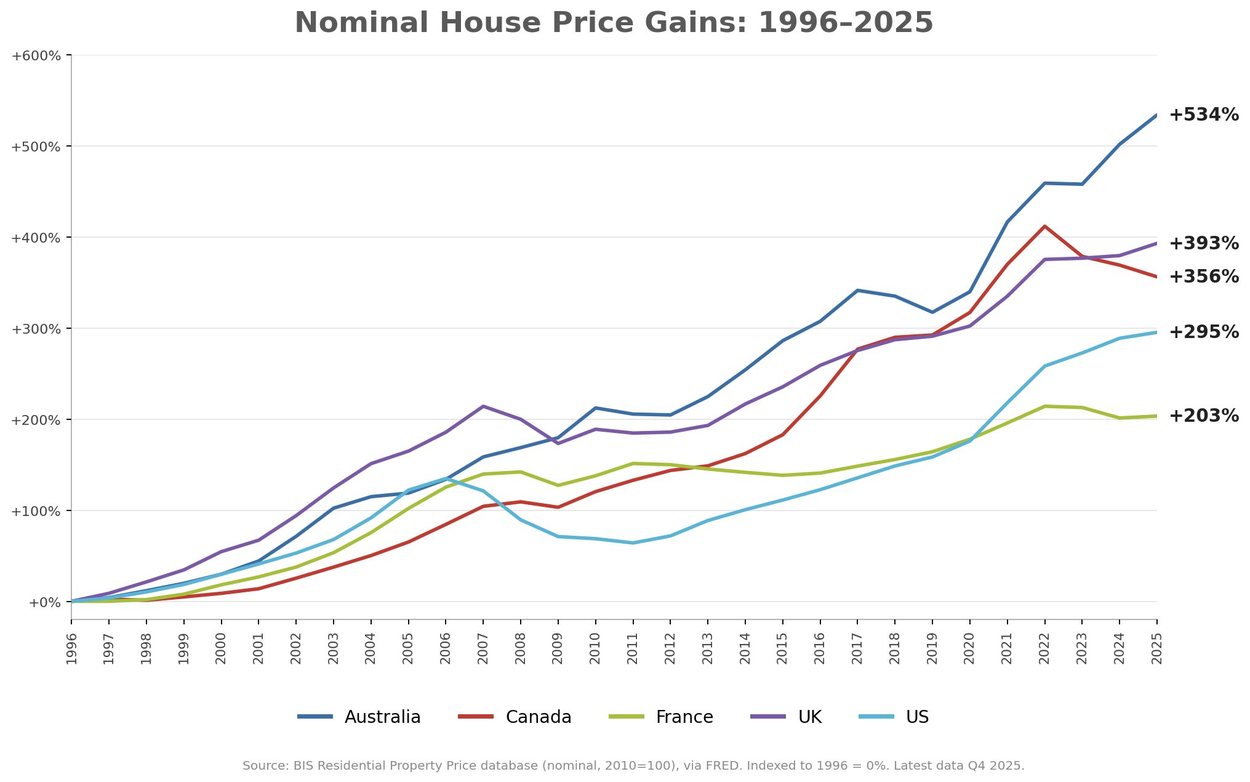
Chart from the investor deck. Source attribution must be printed beneath it on the live site.
What drives the demand
Strong long-term performance
Australia has recorded significant residential appreciation over forty years, supported by population growth, restricted land supply, immigration, high construction costs and lengthy approvals. The drivers are structural rather than cyclical, which is why the pattern has held across multiple rate cycles.
Fast population growth
The population is projected to reach 40 million by 2060, with immigration targets above 190,000 per year. Growth comes from skilled migration, international students, family migration and returning expatriates — and every one of those people needs somewhere to live.
Persistent housing shortage
Australia is short more than 175,000 homes. The national target of 1.2 million new dwellings by 2029 is significantly off track. Labour shortages, construction costs, government charges and slow approvals have all constrained delivery, supporting rents and values.
Lower oversupply risk
Geography and strict planning limit how fast housing stock can expand. Sydney in particular is hemmed in by national parks, mountains, coastline and zoning — which caps the speed at which new supply can arrive, even when demand is obvious.
Every figure on this page needs an inline citation — ABS, Treasury, or the National Housing Accord.
What makes Australian real estate funds safe
These are features of the Australian market. Not all of them apply to this fund, and we’ve said which do.
APRA & ASIC oversight
AFSL required. Investor capital held in trust, segregated from manager assets.
Applies to this fund? Confirm AFSL position before publication.
Full recourse lending
Australian mortgage law allows lenders to pursue borrowers’ full personal assets on default.
Applies to this fund? Applies to project-level lending, not to your investment in the fund.
Conservative LVR limits
Typically capped at 65–70%, providing an equity buffer.
Applies to this fund? Applies at project level where senior debt is used.
Custodian & trustee structure
Independent licensed custodians hold fund assets. Audited annually.
Applies to this fund? Confirm whether a custodian has been appointed.
Real estate-backed
Capital deployed into project entities that own underlying residential assets.
Applies to this fund? Yes — this is how the fund is structured.
PPSA registered security
Federal register ensuring security interests are perfected and enforceable nationally.
Applies to this fund? Note: the fund does not hold direct mortgage security over individual projects.